Showing posts with label China. Show all posts
Showing posts with label China. Show all posts
Friday, August 08, 2008
China Welcomes You
Mentioning “China”, some would smile, some frown; visiting China, some would be awed and impressed, and some frustrated and disgusted. China is like any other country in the world with its shares of accomplishments and disappointments. As China welcomes the world to the Olympics, the world needs to hug back and say: “Welcome back, and let’s together make China and the world a better place”.


Sunday, May 25, 2008
Une Nouvelle Chine
À 14.28 le 19 Mai, 6 jours après le tremblement de terre ravageur à Szechuan, toute la Chine avait un moment de silence pendant 3 minutes, une coutume chinoise réservée seulemment pour un chef d'état. C’était la première fois pour les sinistrés dans l’histoire de la Chine.
Il y a un tremblement de terre plus dommageable qui a tué plus de 250,000 personnes en 1976. À ce moment-la, la Chine a refusé toute l’aide un tout le média aux pays étrangères, comme le gouvernement de la Birmanie cette année. Maintenant, au contraire, le sauvetage des “goons and thugs” est arrivé beaucoup plutôt que l’Air Force One qui est seulement descendue aux 17,000 pieds au-dessus du Mississippi 4 jours après Katrina et jamais fait atterrir dans la région dévastée.
J’ai quitté la Chine il y 14 ans et le pays a changé de façon significative depuis. Un ne voit pas seulement les gratte-ciel flambants neufs, voitures et restaurants fantaisies, Louis Vuitton et Chanel ominprésent, mais également une entièrement nouvelle génération qui est folle de l’idéologie et philosophie de l’ouest et, en même temps, de l’idée qui la Chine est l’un des plus grands pays au monde.
La Chine rouge a commis beaucoup de fautes dans le passé, mais depuis les années 80 la Chine s’a dégagé de son âge des ténèbres et embrassé le monde. Elle continue à épouser bonnes pratiques telles que l’économie de marché, le fair-play, la protection de la propriété intellectuelle, etc. Le changement le plus important est la transition du centre de l’attention sur l’état en les citoyens. Les sociétés essayent de concevoir merchandises plus humaines; le gouvernement modifie ses routines pour mieux service; les talk shows prospèrent en parlant des vies des personnes ordinaries. Le centre du sauvetage après le tremblement de terre à Szechuan est de sauver les rescapés à tout prix.
Si vous envisagez de saisir une torche d’un athelet amputé encore à l'avenir, regardez ce film :
Il y a un tremblement de terre plus dommageable qui a tué plus de 250,000 personnes en 1976. À ce moment-la, la Chine a refusé toute l’aide un tout le média aux pays étrangères, comme le gouvernement de la Birmanie cette année. Maintenant, au contraire, le sauvetage des “goons and thugs” est arrivé beaucoup plutôt que l’Air Force One qui est seulement descendue aux 17,000 pieds au-dessus du Mississippi 4 jours après Katrina et jamais fait atterrir dans la région dévastée.
J’ai quitté la Chine il y 14 ans et le pays a changé de façon significative depuis. Un ne voit pas seulement les gratte-ciel flambants neufs, voitures et restaurants fantaisies, Louis Vuitton et Chanel ominprésent, mais également une entièrement nouvelle génération qui est folle de l’idéologie et philosophie de l’ouest et, en même temps, de l’idée qui la Chine est l’un des plus grands pays au monde.
La Chine rouge a commis beaucoup de fautes dans le passé, mais depuis les années 80 la Chine s’a dégagé de son âge des ténèbres et embrassé le monde. Elle continue à épouser bonnes pratiques telles que l’économie de marché, le fair-play, la protection de la propriété intellectuelle, etc. Le changement le plus important est la transition du centre de l’attention sur l’état en les citoyens. Les sociétés essayent de concevoir merchandises plus humaines; le gouvernement modifie ses routines pour mieux service; les talk shows prospèrent en parlant des vies des personnes ordinaries. Le centre du sauvetage après le tremblement de terre à Szechuan est de sauver les rescapés à tout prix.
Si vous envisagez de saisir une torche d’un athelet amputé encore à l'avenir, regardez ce film :
Wednesday, April 02, 2008
A Tibetan Riot Or A Chinese Crackdown? A Simple Analysis
On March 15, 2008, there was a violent clash between Tibetan protesters and the police force in Lhasa. Some argue that it was a peaceful demonstration brutally suppressed by the authority. Others insist that it was a violent disturbance from the get-go and the government responded with proper policing measures. Which one is closer to the truth?
Chinese authority released videos a few days after the conflict. However, since no western journalists were allowed in Tibet during the incident, there hasn’t been any first-hand independent coverage. Therefore, the CCTV footage is impermissible.
Without direct evidence, circumstantial evidences and mitigating factors play a stronger role in this case.
Let us assume it was a peaceful protest. The facts are:
1) the demonstration was peaceful
2) no western journalists were in Tibet to report this parade to the outside world
3) the Chinese government, well-known for its censorship, could've easily chosen not to report this incident to anyone
If all of above are true, there seemed to be no motivation for the Chinese government to do anything. The incident can be simply ignored or buried.
In addition, the timing of the conflict is crucial in analysis:
4) on March 24, the Olympic flame was to be lit in Greece
5) Olympic Games were to be held in Beijing 5 months later
For the Chinese government, nothing is more important in 2008 than hosting successful Olympic Games in August. Anything else can wait. It would do anything to avoid any negative publicity at least from now until after the Games. If any negative news leads to actual damage to the Games in August, losing face right at home is unbearable in Asian cultures. Therefore, a priori, cracking down a peaceful and insignificant parade would be the last thing on the to-do list.
On the other hand, 2008 is the best and probably the last time for the Tibetans to stage a successful bid for independence. Besides the Olympics:
6) after the aging Dalai Lama, independence seeking Tibetans will not have a spiritual leader commanding a wide support from the West.
With the Olympics and still outspoken His Holiness, 2008 offers the best opportunity. A violent conflict in Tibet to attract world attention seems to work in great favor of the Tibetans.
When a crime is committed, the first suspect usually is whoever benefits from it the most, and that person usually is the evil doer.
So if you are the jury of this case, how would you decide?
Chinese authority released videos a few days after the conflict. However, since no western journalists were allowed in Tibet during the incident, there hasn’t been any first-hand independent coverage. Therefore, the CCTV footage is impermissible.
Without direct evidence, circumstantial evidences and mitigating factors play a stronger role in this case.
Let us assume it was a peaceful protest. The facts are:
1) the demonstration was peaceful
2) no western journalists were in Tibet to report this parade to the outside world
3) the Chinese government, well-known for its censorship, could've easily chosen not to report this incident to anyone
If all of above are true, there seemed to be no motivation for the Chinese government to do anything. The incident can be simply ignored or buried.
In addition, the timing of the conflict is crucial in analysis:
4) on March 24, the Olympic flame was to be lit in Greece
5) Olympic Games were to be held in Beijing 5 months later
For the Chinese government, nothing is more important in 2008 than hosting successful Olympic Games in August. Anything else can wait. It would do anything to avoid any negative publicity at least from now until after the Games. If any negative news leads to actual damage to the Games in August, losing face right at home is unbearable in Asian cultures. Therefore, a priori, cracking down a peaceful and insignificant parade would be the last thing on the to-do list.
On the other hand, 2008 is the best and probably the last time for the Tibetans to stage a successful bid for independence. Besides the Olympics:
6) after the aging Dalai Lama, independence seeking Tibetans will not have a spiritual leader commanding a wide support from the West.
With the Olympics and still outspoken His Holiness, 2008 offers the best opportunity. A violent conflict in Tibet to attract world attention seems to work in great favor of the Tibetans.
When a crime is committed, the first suspect usually is whoever benefits from it the most, and that person usually is the evil doer.
So if you are the jury of this case, how would you decide?
Monday, March 24, 2008
The Taiwan and Tibet Issue
When your 19-year-old one day comes up to you and says, “You are not my real dad”, or your estranged biological son decides one morning that he wants nothing to do with you because of what you did or what you didn’t do, what would you do?
It’s not uncommon, especially in the Western civilization in which the will and value of an individual is often placed above the common good of the group he belongs to, that an offspring decides to sever its family tie. The cause could be parents being abusive, negligent, distant, or the child being rebellious, emotional, immature, or simply led astray. The parents could try to reach out and make up for what’s missing, if any, but the run-away kid should make the final decision, as long as he or she is legally able, but, unfortunately, not necessarily mature and responsible enough at the same time.
The answer to Taiwan’s and Tibet’s decades-long quest for independence doesn’t lie in history but the present. The decision belongs to the majority of the native inhabitants, however “majority” is defined by international standard, simple or three quarters. When it happens, the decision should be respected.
However, in the global village today, there is more at stake than a sometimes empty title of democracy or independence.
The Mainland-China-friendly Ma Ying-jeou, of Nationalist Party, won a landslide victory in the recent presidential election in Taiwan defeating, by the largest margin in the island’s history, the incumbent Democratic Progressive Party (DPP) which has fiercely sought the island’s formal independence and return to the UN during its 8 reigning years, at the expense of sluggish economy and the declining living standard.
When I visited in Taiwan in 2003, I was shocked to discover that in Taipei’s subway, public announcements were in two languages (English and Mandarin Chinese) and two local dialects. On today’s flat earth where globalization is the inevitable future, Taiwan under the leadership of DPP, was stepping backwards and localizing and isolating its culture to return to its aboriginal form. In 2007 when people around the world were eager to learn Chinese, buy shirts and caps bearing Chinese characters, or even to tattoo them on their skin, DPP started the process of desinicization. One of the mandates was to remove the word “China” from the names of all Taiwanese companies.
Last Saturday, the people of Taiwan stamped an “F” on DPP’s report card for its priority on a quixotic quest for nominal independence over providing milk and bread to the ordinary people. How would the people of Tibet vote when they ponder over the harsh economical realty of an independent Tibet without any vital subsidies from Beijing? By the by, Tibetan economy is an oxymoron. After 5 years of imported over-glorified democracy, the daily life of an average Iraqi seems just as bad as before the war, if not worse. What does democracy and sovereignty mean when you are 肚子扁扁? (a popular political vernacular in Taiwan meaning “empty stomached”, which cleverly rhymes with the name of the lame duck DPP president who has caused the widespread problem.)
But patriots should never sell out sovereignty, right? Just ask the nations who can’t erase their borders fast enough or shred their banknotes quickly enough to join the exclusive country club called the European Union.
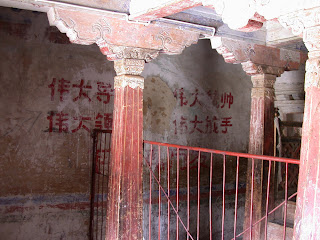
What if the country club is run by a mad man? For some dark hours in the modern Chinese history, especially in the so-called Cultural Revolution, things got out of hands. I saw this in a Tibetan temple.
But it’s a very different time now. Chinese government like any other in the world is not perfect. It is vigorously improving itself. For the last 30 years, it has continuously placed economical growth and prosperity of its people above all other objectives, just as the new Taiwan president-elect promised to do in his own term. How is China doing nowadays as a result? It’s not a trick question.
What if the regime is still run by a tyrant? The answer lies quietly in a fortress called Masada in the Judean desert.

The story of rebelling Jews, commonly referred to as Sicarii zealots, chose mass suicide over surrendering to the ruling Romans didn’t survive as a heroic legend, but as a shame (until reevaluated by the Zionists to support the ideology of the modern State of Israel). The fact that it was only found in the writings of Josephus who, ironically, escaped a similar mass suicide and surrendered to the Romans, indicated that the Jewish people disapproved the act. Most modern historians concur that the appropriately labeled zealots defending Masada should have negotiated with the Romans, who in fact were surprisingly tolerant, contrary to popular belief (of course, before the great Christian Emperor came along). Violence has never been the answer. The recent turmoil in Tibetan areas will not become anything but another embarrassment in history.
The Taiwan and Tibet issue may be an issue today, but as the globalization, economic development, and democratic improvement progress, the political and economical borders in the region will be too faint to notice. The hot spots will become non issues. And that is probably the best solution.
It’s not uncommon, especially in the Western civilization in which the will and value of an individual is often placed above the common good of the group he belongs to, that an offspring decides to sever its family tie. The cause could be parents being abusive, negligent, distant, or the child being rebellious, emotional, immature, or simply led astray. The parents could try to reach out and make up for what’s missing, if any, but the run-away kid should make the final decision, as long as he or she is legally able, but, unfortunately, not necessarily mature and responsible enough at the same time.
The answer to Taiwan’s and Tibet’s decades-long quest for independence doesn’t lie in history but the present. The decision belongs to the majority of the native inhabitants, however “majority” is defined by international standard, simple or three quarters. When it happens, the decision should be respected.
However, in the global village today, there is more at stake than a sometimes empty title of democracy or independence.
The Mainland-China-friendly Ma Ying-jeou, of Nationalist Party, won a landslide victory in the recent presidential election in Taiwan defeating, by the largest margin in the island’s history, the incumbent Democratic Progressive Party (DPP) which has fiercely sought the island’s formal independence and return to the UN during its 8 reigning years, at the expense of sluggish economy and the declining living standard.
When I visited in Taiwan in 2003, I was shocked to discover that in Taipei’s subway, public announcements were in two languages (English and Mandarin Chinese) and two local dialects. On today’s flat earth where globalization is the inevitable future, Taiwan under the leadership of DPP, was stepping backwards and localizing and isolating its culture to return to its aboriginal form. In 2007 when people around the world were eager to learn Chinese, buy shirts and caps bearing Chinese characters, or even to tattoo them on their skin, DPP started the process of desinicization. One of the mandates was to remove the word “China” from the names of all Taiwanese companies.
Last Saturday, the people of Taiwan stamped an “F” on DPP’s report card for its priority on a quixotic quest for nominal independence over providing milk and bread to the ordinary people. How would the people of Tibet vote when they ponder over the harsh economical realty of an independent Tibet without any vital subsidies from Beijing? By the by, Tibetan economy is an oxymoron. After 5 years of imported over-glorified democracy, the daily life of an average Iraqi seems just as bad as before the war, if not worse. What does democracy and sovereignty mean when you are 肚子扁扁? (a popular political vernacular in Taiwan meaning “empty stomached”, which cleverly rhymes with the name of the lame duck DPP president who has caused the widespread problem.)
But patriots should never sell out sovereignty, right? Just ask the nations who can’t erase their borders fast enough or shred their banknotes quickly enough to join the exclusive country club called the European Union.
What if the country club is run by a mad man? For some dark hours in the modern Chinese history, especially in the so-called Cultural Revolution, things got out of hands. I saw this in a Tibetan temple.
But it’s a very different time now. Chinese government like any other in the world is not perfect. It is vigorously improving itself. For the last 30 years, it has continuously placed economical growth and prosperity of its people above all other objectives, just as the new Taiwan president-elect promised to do in his own term. How is China doing nowadays as a result? It’s not a trick question.
What if the regime is still run by a tyrant? The answer lies quietly in a fortress called Masada in the Judean desert.
The story of rebelling Jews, commonly referred to as Sicarii zealots, chose mass suicide over surrendering to the ruling Romans didn’t survive as a heroic legend, but as a shame (until reevaluated by the Zionists to support the ideology of the modern State of Israel). The fact that it was only found in the writings of Josephus who, ironically, escaped a similar mass suicide and surrendered to the Romans, indicated that the Jewish people disapproved the act. Most modern historians concur that the appropriately labeled zealots defending Masada should have negotiated with the Romans, who in fact were surprisingly tolerant, contrary to popular belief (of course, before the great Christian Emperor came along). Violence has never been the answer. The recent turmoil in Tibetan areas will not become anything but another embarrassment in history.
The Taiwan and Tibet issue may be an issue today, but as the globalization, economic development, and democratic improvement progress, the political and economical borders in the region will be too faint to notice. The hot spots will become non issues. And that is probably the best solution.
Wednesday, November 28, 2007
History, can be forgiven, but never forgotten!
On ne doit pas comprendre l’histoire, mais la comparer. Die Deutschen haben sich vor Dekaden dafür entschuldigt, was sie den Juden angetan haben. Sie haben Auschwitz nicht vergessen. 日本人は今まで中国に侵入のために正式謝罪したことがありません。日本人は南京を全然思い出しません。L’histoire, ce peut être pardonnée, mais jamais oubliée.


A powerful, emotional and relevant reminder of the heartbreaking toll war takes on the innocent, Nanking tells the story of the Japanese invasion of Nanking, China, in the early days of World War II. As part of a campaign to conquer all of China, the Japanese subjected Nanking – which was then China’s capital – to months of aerial bombardment, and when the city fell, the Japanese army unleashed murder and rape on a horrifying scale. In the midst of the rampage, a small group of Westerners banded together to establish a Safety Zone where over 200,000 Chinese found refuge. Unarmed, these missionaries, university professors, doctors and businessmen – including a Nazi named John Rabe – bore witness to the events, while risking their own lives to protect civilians from slaughter.
The story is told through deeply moving interviews with Chinese survivors, chilling archival footage and photos of the events, and testimonies of former Japanese soldiers. At the heart of Nanking is a filmed stage reading of the Westerners’ letters and diaries, featuring Woody Harrelson, Mariel Hemingway and Jurgen Prochnow. Through its interweave of archival images, testimonies of survivors, and readings of first hand accounts, the film puts the viewer on the streets of Nanking and brings the forgotten past to startling life.
Nanking is a testament to the courage and conviction of individuals who were determined to act in the face of evil and a powerful tribute to the resilience of the Chinese people – a gripping account of light in the darkest of times.


Minnie Vautrin

John Rabe
A powerful, emotional and relevant reminder of the heartbreaking toll war takes on the innocent, Nanking tells the story of the Japanese invasion of Nanking, China, in the early days of World War II. As part of a campaign to conquer all of China, the Japanese subjected Nanking – which was then China’s capital – to months of aerial bombardment, and when the city fell, the Japanese army unleashed murder and rape on a horrifying scale. In the midst of the rampage, a small group of Westerners banded together to establish a Safety Zone where over 200,000 Chinese found refuge. Unarmed, these missionaries, university professors, doctors and businessmen – including a Nazi named John Rabe – bore witness to the events, while risking their own lives to protect civilians from slaughter.
The story is told through deeply moving interviews with Chinese survivors, chilling archival footage and photos of the events, and testimonies of former Japanese soldiers. At the heart of Nanking is a filmed stage reading of the Westerners’ letters and diaries, featuring Woody Harrelson, Mariel Hemingway and Jurgen Prochnow. Through its interweave of archival images, testimonies of survivors, and readings of first hand accounts, the film puts the viewer on the streets of Nanking and brings the forgotten past to startling life.
Nanking is a testament to the courage and conviction of individuals who were determined to act in the face of evil and a powerful tribute to the resilience of the Chinese people – a gripping account of light in the darkest of times.
Saturday, November 10, 2007
Subscribe to:
Posts (Atom)